

.jpg?width=720&height=900&name=Imagery%20(83).jpg)
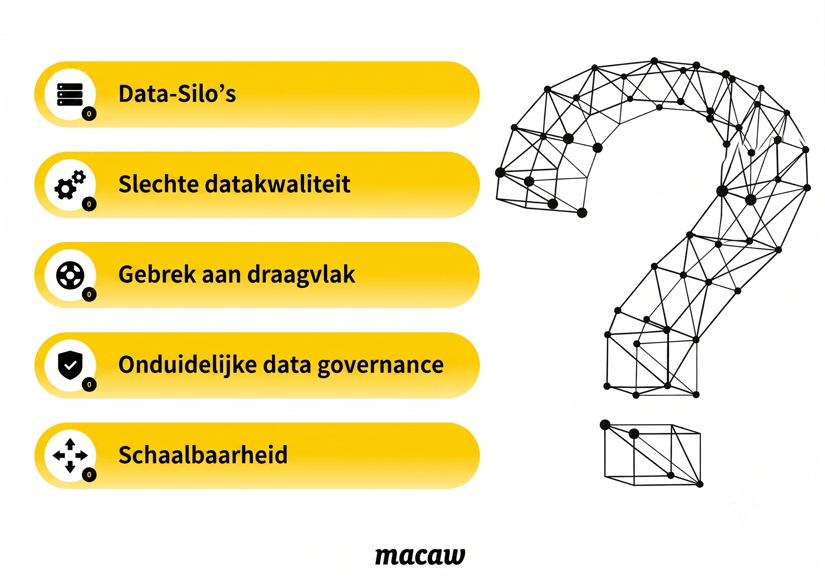
1. Data Silos: Data trapped in separate systems
The problem:
Many organizations have data spread across multiple systems (such as CRM, ERP, and marketing tools). These “data silos” make collaboration difficult and lead to conflicting information.
The solution:
- Centralize data: Choose an MDM platform that can consolidate data from different systems.
- Automate integrations: Use technologies such as APIs and ETL (Extract, Transform, Load) tools to automatically synchronize data.
- Encourage collaboration: Ensure that IT and other departments are involved in connecting data.
2. Poor data quality: Duplicate and outdated data
The problem:
Inaccurate or inconsistent data is a common problem. Think of duplicate customer records or incorrect product information. This leads to inefficiency, poor decisions, and missed opportunities.
The solution:
- Use data quality tools: These tools detect and correct duplicate or incomplete data.
- Set standards: Ensure that, for example, customer names, addresses, and product codes are entered in a consistent manner.
- Check regularly: Schedule periodic audits to monitor data quality and resolve issues early on.
3. Lack of organizational buy-in
The problem:
MDM projects often fail because employees and managers do not recognize their value. Without commitment, MDM cannot succeed.
The solution:
- Explain the benefits: Demonstrate specifically how MDM increases efficiency and saves costs.
- Involve users: Actively ask teams for input on the system’s design. This increases adoption.
- Start small: Achieve “quick wins” by first solving one specific problem (such as duplicate customer data), and then expand.
4. Unclear data governance: Who is responsible?
The problem:
In many organizations, it’s unclear who is responsible for which data. This leads to conflicts and errors, such as unauthorized changes or missing updates.
The solution:
- Appoint Data Stewards: These are employees responsible for a specific type of data (such as customer or product data).
- Establish guidelines: Create guidelines regarding who is authorized to modify data and how.
- Use technology: Tools such as data lineage software make it easy to track the origin and changes to data.
5. Scalability: Growth Brings Complexity
The problem:
As an organization grows, managing data becomes increasingly complex. Consider new product lines, markets, and acquisitions. The existing MDM system often cannot handle this growth.
The solution:
- Choose scalable solutions: Modern cloud-based MDM tools can grow alongside your organization.
- Automate processes: Use AI and machine learning to analyze patterns in data and reduce manual tasks.
- Stay flexible: Keep your MDM strategy dynamic and adjust processes as needed.
Why MDM Is More Important Now Than Ever
The amount of data organizations collect continues to grow exponentially. Without proper management, data becomes a problem rather than an asset. Successful companies therefore invest in MDM to:
- Make decisions faster and more effectively.
- Offer customers personalized experiences.
- Stay flexible in an ever-changing market.
Getting Started with MDM
At Macaw, we help you manage and leverage data more efficiently with a well-thought-out Master Data Management (MDM) strategy. With the right approach, you’ll lay a solid foundation for better decisions, higher data quality, and greater flexibility in a rapidly changing market. Want to discover how MDM can help your organization move forward? Download our comprehensive white paper on the strategic importance of master data management.
%201.jpg?width=720&name=michel%20heijman%20(3)%201.jpg)
 Michel Heijman
.jpg?width=720&name=Imagery%20(115).jpg)
 Macaw
Macaw