
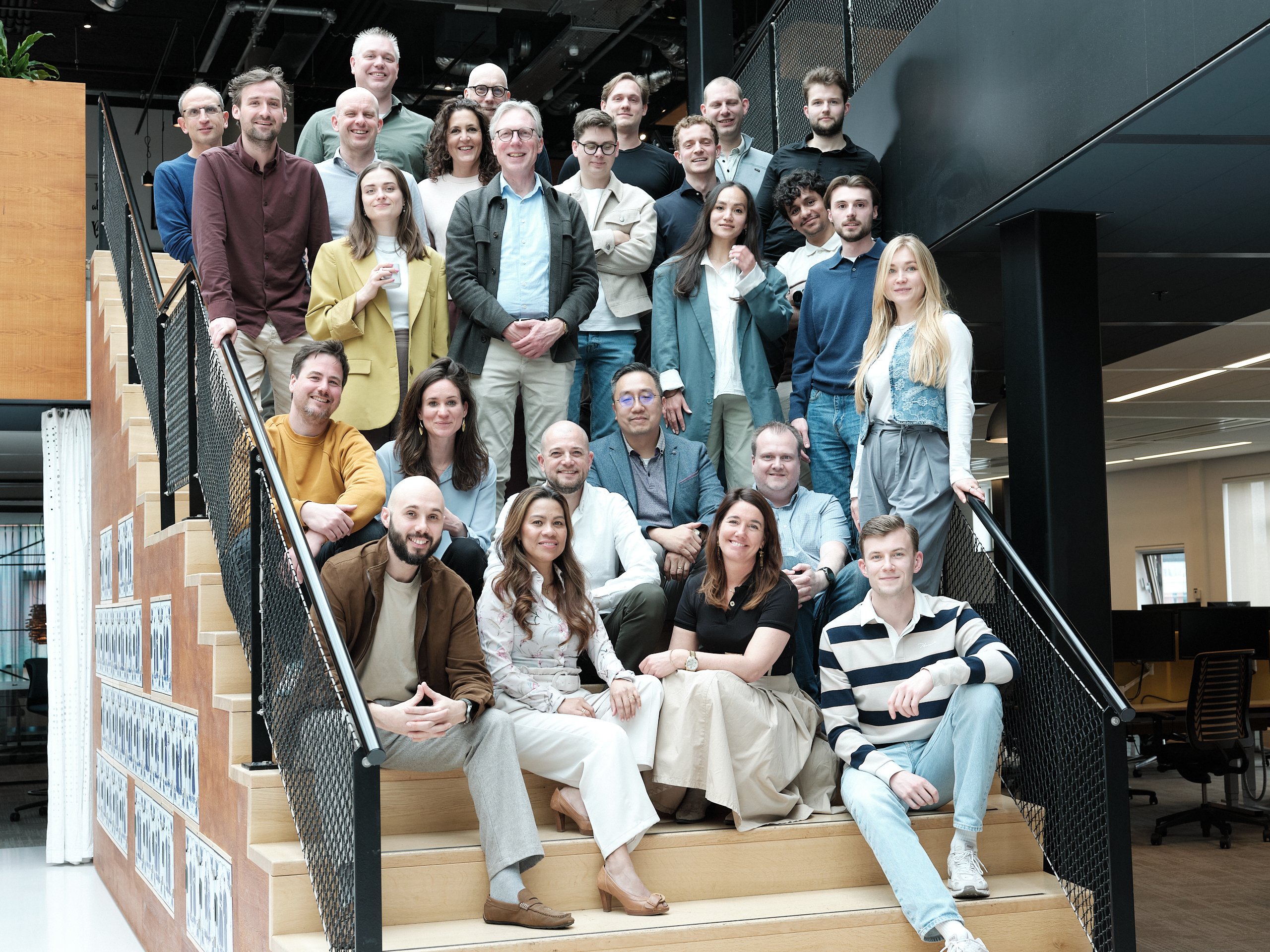
Our History
Macaw's Journey
For over 30 years, Macaw has been at the forefront of technology and innovation. From the very beginning, we’ve helped people and organizations navigate the digital world. Over the past thirty years, we’ve witnessed—and embraced—one technological revolution after another. From the rise of the internet to the AI revolution, we’ve consistently stayed ahead of the curve. Join us on a journey back in time and discover how reinvention is in our DNA.
1994: The Year Macaw Was Founded
The story begins on July 7, 1994, in a small office in Leiden. Two recent college graduates, Roel Bergsma and Maarten Sikkema, shared a passion for technology and founded Macaw with a clear goal: to make technology accessible and valuable for organizations.
As software developers, they recognized the potential of the internet early on, even though it was still in its infancy. At that time, companies were still distributing digital content via CD-ROM, so Roel and Maarten started out doing just that: creating rich multimedia experiences on disc. When the internet and the first browsers, such as Internet Explorer and Netscape, rapidly gained ground, they saw that shift coming. They quickly made the transition from CD-ROMs to building websites—the foundation for Macaw’s future in digital transformation.
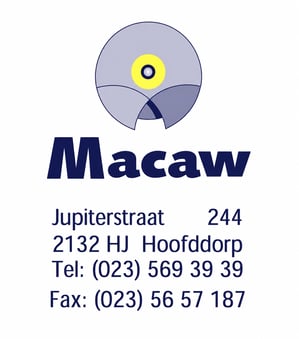
Then came the next challenge: choosing a name. They needed an available domain name, but how do you choose something that really stands out? Their solution: a blindfold, a world map, and a little luck. With their eyes closed, they randomly pointed to a spot—Macau. That’s how, by chance, the Macaw brand was born. The name stuck, and as a nod to their early days in multimedia, the first Macaw logo featured a parrot shaped like a CD.
This love for technology, creativity, and innovation has been in our DNA ever since. And that’s how our journey began.
The Internet Era (mid-1990s)
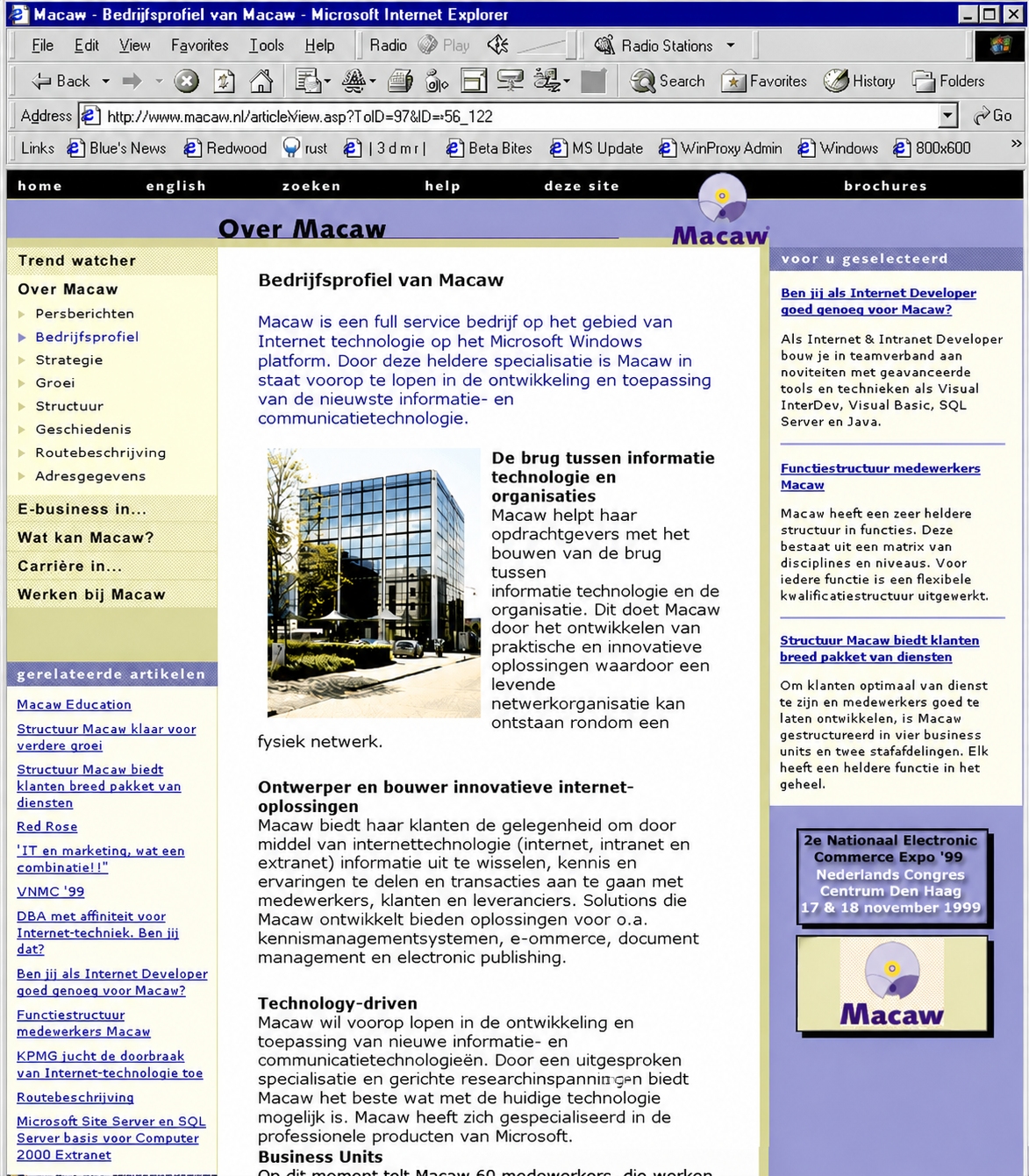
The Internet era began in the mid-1990s. Web 1.0 brought static websites: simple pages with company information, built using basic HTML. It was a time of discovery. Companies saw the potential of an online presence but didn’t yet know exactly what was possible. For Macaw, this period was about seizing those early opportunities—and making a choice that would prove decisive.
While building websites for clients such as Douwe Egberts and Amsterdam Tourist, we realized that organizations needed more than just a website: they needed internal platforms to facilitate communication and collaboration. Intranets were a new concept, and we recognized the potential of Microsoft technology as the foundation for these solutions. From that moment on, we chose to focus entirely on Microsoft technology. That decision gave us the in-depth knowledge needed to remain at the forefront of digital business solutions.
This decision not only shaped our future but also strengthened our relationship with Microsoft. To seal that partnership, we even moved our headquarters to Hoofddorp, near Microsoft’s Dutch headquarters.
The Era of Transactional Web Stores (Late 1990s)
The Internet matured, and Web 2.0 made its debut: more interactive and dynamic websites, thanks to technologies like XML, JavaScript, and PHP. This also led to the emergence of transactional online stores—companies could now not only share information but also actually sell products online.
We love a challenge and are always curious about new technology, so we embraced this shift and kept learning. By linking databases and local intranets to websites, we made early e-commerce possible for clients like HEMA. Our in-depth exploration of Microsoft Commerce Server and .NET laid the foundation for a new wave of digital commerce.
The Era of Data and Business Intelligence (Early 2000s)
Digital was growing rapidly, and with every click, purchase, and interaction, more data was generated. Data became the new gold: it provided insights, improved processes, and helped drive smarter decisions. But raw data alone wasn’t enough—companies needed the right tools to truly make use of it.
Yet another challenge we were happy to tackle. We were among the first to start working with business intelligence tools such as Microsoft’s SSIS, SSAS, and SSRS, which enabled clients to integrate, analyze, and visualize their data. At the same time, IT environments were becoming more complex, and traditional storage solutions were reaching their limits. Cloud computing emerged as the solution. Our portfolio continued to grow, and with increasing experience, we helped companies turn information into real value.
The Cloud Era (late 2000s)
Cloud computing transformed the IT world. It offered unprecedented scalability, flexibility, and cost savings. The days of expensive investments in on-premises infrastructure were over—companies could now innovate faster through the cloud and easily adapt to changing needs.
As a Microsoft partner, we embraced the cloud with Microsoft Azure. We fully adopted this technology and expanded our expertise, enabling us to deliver faster and explore new areas, such as mobile technology. With the rise of the smartphone, we helped clients develop intuitive apps that allowed them to reach their customers in new and surprising ways.
This growth and our approach to work were also recognized externally: in 2006, Macaw received the award for Best IT Employer in the Netherlands.
The Age of AI (Now)
2023 marked a turning point in the AI revolution. AI has been around for decades, but it wasn’t until the arrival of ChatGPT in November 2022 that the technology became accessible to everyone. This breakthrough, followed by the rapid integration of AI into the Microsoft ecosystem—through Copilot, Azure OpenAI, and more—opened the door to AI for businesses worldwide.
We don’t see AI as a replacement for people, but as an accelerator of innovation, creativity, and efficiency. We focus on real, measurable impact for businesses. We’ve always been at the forefront of new technology, and AI is no exception. We help clients navigate the complexity of today’s digital landscape so they’re ready for the future and can stand out from the competition.
As AI continues to evolve, we look forward to tackling new challenges and discovering all that this technology has to offer.